
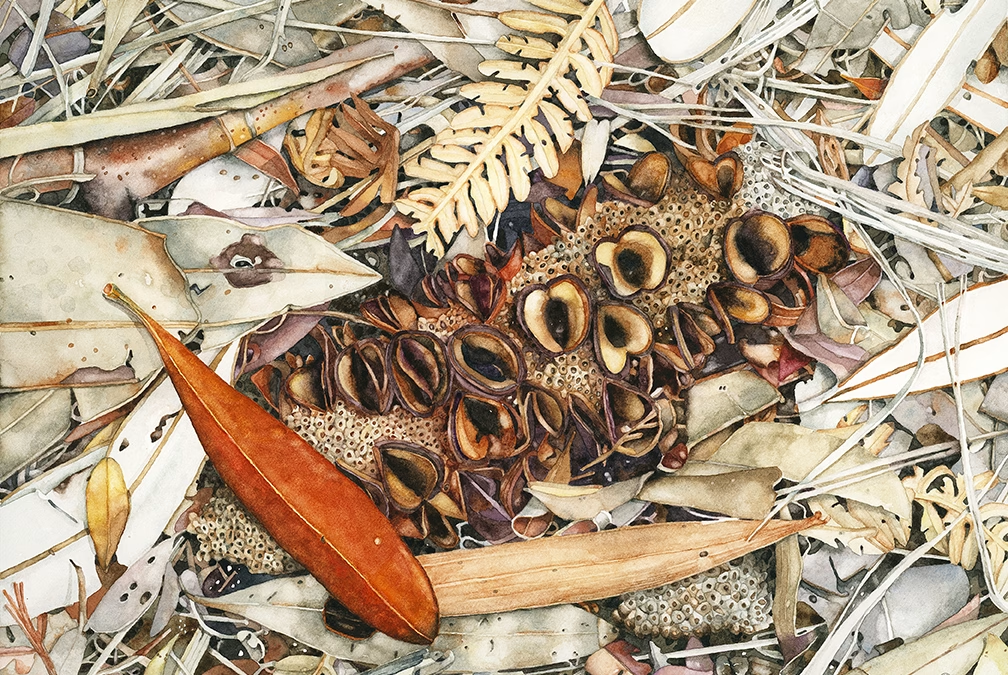
I said to myself that I would never take a commission. It wasn’t part of my business plan. Having worked for clients as a freelance art director-slash-graphic designer for 25+ years, I didn’t relish having clients again.
Ne jamais dire jamais. Never say never. At the artist’s reception for my solo exhibit, Tiny Universes Everywhere at Silverwood Park, I was asked if I would consider taking on a commission.
It was as if the Universe was conspiring. The person asking is a talented professional photographer whose work I admire greatly. She had a photograph from the Australian bush that she would love to have me watercolor. From seeing my work over the past couple of years, she knew I would be an ideal candidate for the project. She would show me the photograph and let me decide.
The featured watercolor above is titled “Australian Bushland,” 11 x 14-inch on 300 lb. Fabriano Hotpress paper.
When I saw the photograph, I immediately had a full body “Yes!” That doesn’t happen often. The reason why I said yes wasn’t because I loved the textures, the colors, and the wild chaos of it all shown in the image.
When I looked into the photograph, I knew that bushland, however brief. I spent a month in Australia when I was just turning 30 and went to visit my parents, who were on an academic exchange at the University of New South Wales. The land, the sea, the gum trees, and the red soil all had an impact on me. The country felt enlightened and wild at the same time.
So even though the image I was to represent in watercolor is not from my native Minnesota, it still felt authentic to me because I had witnessed and felt what Australia is like, even if it was for a brief time.
What made this commission even more appealing?
Small size. We agreed on an 11-by-14-inch painting. With all the details involved, that size was manageable.
Deadline. None. My patron knows what it’s like, as an artist and photographer, and that she would never want to impose a deadline on a fellow artist.
I began the project in October and completed it right before Christmas. In October, I suddenly lost my step-mom and my youngest brother. I then had the daunting task of moving my 93-year-old father from Maryland back home to Minnesota.
Working on this watercolor painting was a balm and a refuge compared to everything that was going on in my life. I will be forever grateful that there wasn’t a deadline to add to the stress.
Price. We agreed on what she could afford. I was that much in love with the project. It’s important that I learn something from every watercolor painting I make — color and techniques, and by doing this piece, I did. I also knew I would spend a lot more time and would have charged 3x more under different circumstances. At the same time, this was a learning experience. (Priceless).
Between the holidays, she stopped by my studio to pick up the finished watercolor and was completely thrilled with the results. Had I not been devoted to the project, it would have shown in the work.
Would I take on another commission? It depends.
What projects do I have that have deadlines? That is, preparing a new body of work for exhibition.
Most importantly, does the commission align with my values, my experience, and my perspectives as an artist?
Do I like and respect the person asking for a commissioned piece? Do they love and know my work?
There are conditions in which I will always say NO to a commission. For example, if I were asked to paint a pet portrait, I would say no because I don’t do pet portraits. (I do know three artists who are fabulous at painting pet portraits that I could refer them to.
I would also say no to landscapes, animals (because my work isn’t there yet), and anything dealing with fantasy and fairies. You get the picture.
Things to consider before committing to a commission.
Final thoughts on commissions to consider, or considerations if you are asking an artist to take on a commission.
How busy is the shop and the studio? Can I manage sales and fulfillment in a timely fashion?
Taking on art commissions is another level of professionalism for an artist. It’s knowing when a commission is a good fit and when to say no. Verbal agreements are made between the artist and the client to begin the process. However, the artist should (and I highly recommend) have a written contract in place outlining the verbal agreement, the timeframe (when the work is estimated to be complete), materials and the costs involved, if the completed piece needs to be shipped, who is responsible for framing if required, and the final price for the final artwork. Both you, the artist, and the client sign and date the contract.
Other things to include in a commission contract are whether the client sees primary drawings of the composition and color palette before work begins in earnest. How many changes are allowed? How large should the piece be? Does the client provide visuals that the work should be based on, such as a specific building or landscape? In the case of abstract painting, the artist should prepare questions for the client to understand what emotions and colors the piece will evoke.
As the artist, you should note in your contract that you retain the copyright to the artwork. That means you are free to sell art prints of the piece or apply it to various products where it makes sense.
Need a commission contract? Here’s one to get you started. Keep in mind this is a template and to consult with a legal professional regarding your specific situation.
Your turn.
Are commissions part of your art practice and business? What have you learned in taking on commissions?
Flip side: Have you ever commissioned an artist to create a work of art for you? How did the working relationship go?

Astounding work as always. The details that make your artwork so explorable and the commentary that explains how you approach your craft. Always a joy to see your new works and hear your profound insights.
Thank you, thank you, Kirstin, for being willing to take on my commission. At the time I asked you, I had no idea it was your first. This makes the finished piece even more special to me. As artists I feel like you and I share a certain vibe and spirit. It means the world to me to have that connection embodied in this beautiful piece. Australia is a part of my soul and this absolutely gorgeous work carries so much significance at so many levels. I absolutely treasure this piece and am so honored to have an original Kristin Maija Peterson watercolor hanging in my home.
Thank you for taking the time to post here and for your generous and kind words, Sarah. May I use this as a testimonial? I’m thinking commissions could be in my future.