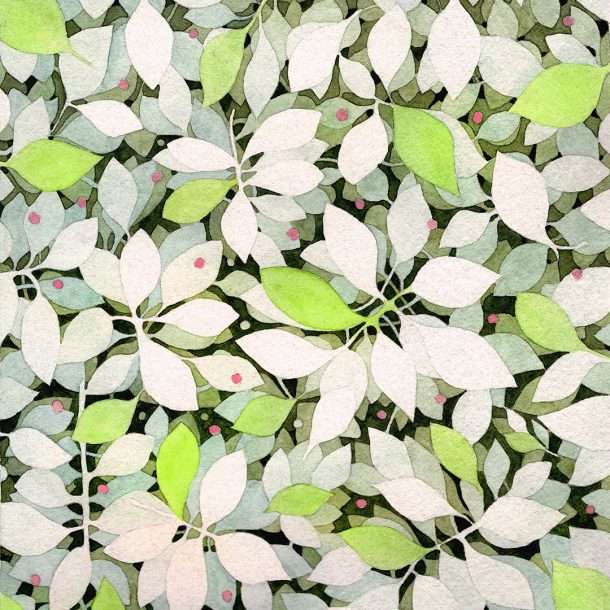
A Story About Plants, Friendship & Community.
I love how this turned out, not so much the watercolor painting, but the fact that I paid attention. The story goes like this. In spring, I planted Nasturtium seeds that didn’t last long after sprouting their lily pad-like leaves. Miss Rabbit and her daughter ate all their tender shoots.
Then one day, I spotted Nasturtium coming up at the edge of the garden where I had first planted it. Around the Nasturtium, starting from the top (you can’t see much from the watercolor), is native Canadian Horseweed. The three prominent ladies surrounding the Nasturtium are Bitter Nightshade. Growing at the top and bottom of the Nasturtium is Pale Willowherb. Growing under the Nasturtium is Broad-leaf Plantain (boy, is there folklore about this plant!) Sprinkled all around everyone is Wood Sorrel.

The Garden Nature Grows. Professional-grade watercolors on Twin Rocker handmade paper. 8 x 8 inches (20 x 20 cm)
The Garden Nature Grows is available as a limited-edition fine art print.
My theory of why the Nasturtium didn’t again meet its demise by Miss Rabbit is that she had friends and community around her. Her fellow plants disguised her in plain sight. This is a story of resiliency, collaboration, and making a tiny patch in my garden beautiful. They did this on their own.


Views from my garden and inspiration for this story and watercolor painting. On the left is a view of the little plot of garden in mid-July. On the right is the same view in mid-October. Sadly, all of these plants got a late start. We’ve already had a few light freezes, so none of these will have a chance to see their full potential this season.
Botanical Notes
Pale Willowherb (Epilobium roseum) is a member of the evening-primrose family, Onagraceae. It’s related to Fireweed, which is used as a sweetener. Sorry, I couldn’t find much more interesting information about this plant other than that people are quick to pull it out of their gardens.
Canadian Horseweed (Erigeron canadensis) is native and a member of the Asteraceae (Aster Family), also called Canada Fleabane. It has those tiny 1/8 aster-like flowers with 20-40 minute white rays (petals) around a yellow center. It can grow from 6 inches to 7 feet!
Broad-leaf Plantain (Plantago major) is a member of the Plantaginaceae family. At first, I thought it belonged to the same family as Hosta. I stand corrected, and this is a common mistake. Hostas belong to the Asparagaceae family.
SOME FOLKLORE: As the legend goes, Plantain was a young girl who longed for her lover’s return and spent so much time watching and waiting for him by the roadside that she eventually transformed into this common roadside plant.
Plantain is one of nine sacred herbs of the ancient Saxons and an early Christian symbol of the path followed by the multitudes of the devout.
It derives one of its common names, White Man’s Foot, from Native American folklore, as the plant seemed to follow the path of the white settlers everywhere they went.
Wood Sorrel (Oxalis acetosella) is a member of the Oxalidaceae family, named for the oxalis acid it produces. Sometimes nicknamed sourgrass, wood sorrel is edible and has a strong lemony flavor, best eaten before flowering. It was eaten to prevent scurvy when citrus was not available.
Bitter Nightshade (Solanum dulcamara) is a member of the Solanaceae family, the same as potatoes and tomatoes. Native to Europe and Asia, it is widely naturalized everywhere, including North America.
Solanum dulcamara has been used as a symbol of fidelity. This is about its curious property of combining extreme bitterness with surprising sweetness – hence its name “bittersweet.” Its symbolism is seen in Christian art from the Middle Ages as well as in bridal wreaths.
And the Nasturtium? Sadly, my saved seed packet doesn’t tell me any more than how to plant her by seed and what to expect. Nasturtium (Tropaeolaceae magus) is a member of the Tropaeolaceae, native to South and Central America. My first encounter with Nasturtium was when it was served at breakfast at the Waipio Wayside B&B on the Big Island of Hawaii. Her blooms are edible with a peppery, pleasing flavor.
Thank you for reading. Till next time, be kind to everything that lives and especially be kind to yourself.
Your Turn.
I welcome comments and respond to all.