A view of stones worn round by water as seen along the North Shores of Lake Superior, Minnesota. Photograph courtesy of Mary Pat McNeil / MP&G Marketing Solutions, LLC.
Some of us are drawn to stones in ways that defy explanation. Suddenly, a stone will catch our eye, and we are compelled to pick it, feel the cool earthy smoothness, and the weight of it in our hand. The stone makes it into our pocket and back to our studio. Then the work begins.
Ever since my partner teased me about picking up random stones left behind from road construction, I have become slightly obsessed with how stones have played a part in human history and the meaning of stones in cultures.
From baetylus to divinations, stones are both from this world but are seen as having otherworldly powers. Our common ancestor,the Neanderthals, were stone experts, the first geologists. They knew where the best stones for the task were located and were highly adept at adapting any stone into any tool necessary.
I am just scratching the stone surface. I hope to bring this exploration to light with a fully developed art exhibition. At the moment, I am at the sketchbook stage and enjoying making these thumbnail sketches. Each one is different. I can’t seem to repeat myself exactly — which is wonderful. The possibilities could be endless.
Stone Watercolor Studies
Each one of these sketches seems to have a story to tell. Not about the stones themselves or the earth or space from which they came, but about the human condition. We all want to have control over our lives, and yet we control nothing. Life is both joy and struggle. We seek harmony and balance and have difficulty arriving at either state. (Painted with watercolors, soil mixed with water, and ink made from buckthorn berries on Twin Rocker artisan paper).
That’s it for now. Stay tuned as this percolates. I’ll be posting progress and processes in the future. A book that has become an inspiration for my Stones Project is Turning to Stone: Discovering the Subtle Wisdom of Rocksby Marcia Bjornerud. She makes structural geology feel spiritual.
Your turn.
Have a budding project you’d like to share? I would love to hear about it, as well as any thoughts on this Stones project you might have. I respond to all. Thank you for stopping by. Be kind to everything that lives, and especially be kind to yourself.
The Stone Project. See the ongoing body of work inspired by one question.
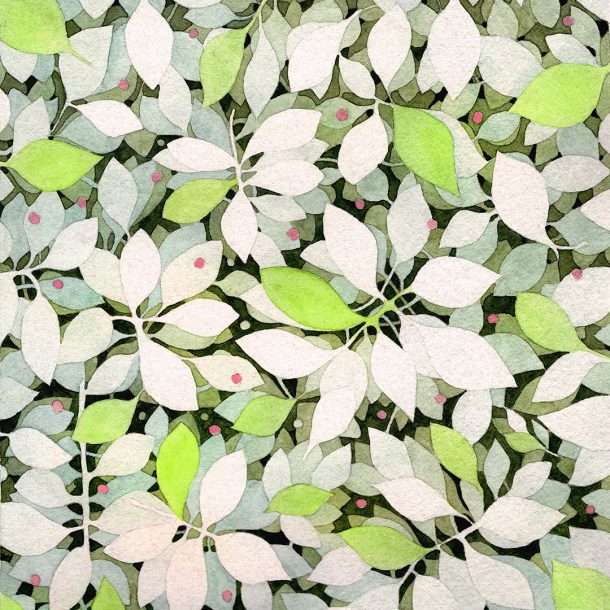
I love how this turned out, not so much the watercolor painting, but the fact that I paid attention. The story goes like this. In spring, I planted Nasturtium seeds that didn’t last long after sprouting their lily pad-like leaves. Miss Rabbit and her daughter ate all their tender shoots.
Then one day, I spotted Nasturtium coming up at the edge of the garden where I had first planted it. Around the Nasturtium, starting from the top (you can’t see much from the watercolor), is native Canadian Horseweed. The three prominent ladies surrounding the Nasturtium are Bitter Nightshade. Growing at the top and bottom of the Nasturtium is Pale Willowherb. Growing under the Nasturtium is Broad-leaf Plantain (boy, is there folklore about this plant!) Sprinkled all around everyone is Wood Sorrel.
My theory of why the Nasturtium didn’t again meet its demise by Miss Rabbit is that she had friends and community around her. Her fellow plants disguised her in plain sight. This is a story of resiliency, collaboration, and making a tiny patch in my garden beautiful. They did this on their own.
Views from my garden and inspiration for this story and watercolor painting. On the left is a view of the little plot of garden in mid-July. On the right is the same view in mid-October. Sadly, all of these plants got a late start. We’ve already had a few light freezes, so none of these will have a chance to see their full potential this season.
Botanical Notes
Pale Willowherb (Epilobium roseum) is a member of the evening-primrose family, Onagraceae. It’s related to Fireweed, which is used as a sweetener. Sorry, I couldn’t find much more interesting information about this plant other than that people are quick to pull it out of their gardens.
Canadian Horseweed (Erigeron canadensis) is native and a member of the Asteraceae (Aster Family), also called Canada Fleabane. It has those tiny 1/8 aster-like flowers with 20-40 minute white rays (petals) around a yellow center. It can grow from 6 inches to 7 feet!
Broad-leaf Plantain (Plantago major) is a member of the Plantaginaceae family. At first, I thought it belonged to the same family as Hosta. I stand corrected, and this is a common mistake. Hostas belong to the Asparagaceae family.
SOME FOLKLORE: As the legend goes, Plantain was a young girl who longed for her lover’s return and spent so much time watching and waiting for him by the roadside that she eventually transformed into this common roadside plant.
Plantain is one of nine sacred herbs of the ancient Saxons and an early Christian symbol of the path followed by the multitudes of the devout.
It derives one of its common names, White Man’s Foot, from Native American folklore, as the plant seemed to follow the path of the white settlers everywhere they went.
Wood Sorrel (Oxalis acetosella) is a member of the Oxalidaceae family, named for the oxalis acid it produces. Sometimes nicknamed sourgrass, wood sorrel is edible and has a strong lemony flavor, best eaten before flowering. It was eaten to prevent scurvy when citrus was not available.
Bitter Nightshade (Solanum dulcamara) is a member of the Solanaceae family, the same as potatoes and tomatoes. Native to Europe and Asia, it is widely naturalized everywhere, including North America.
Solanum dulcamara has been used as a symbol of fidelity. This is about its curious property of combining extreme bitterness with surprising sweetness – hence its name “bittersweet.” Its symbolism is seen in Christian art from the Middle Ages as well as in bridal wreaths.
And the Nasturtium? Sadly, my saved seed packet doesn’t tell me any more than how to plant her by seed and what to expect. Nasturtium (Tropaeolaceae magus) is a member of the Tropaeolaceae, native to South and Central America. My first encounter with Nasturtium was when it was served at breakfast at the Waipio Wayside B&B on the Big Island of Hawaii. Her blooms are edible with a peppery, pleasing flavor.
Thank you for reading. Till next time, be kind to everything that lives and especially be kind to yourself.
Friends, I will tell you DOING is so much better than watching. Please note that I am posting this much later. The mini-course is over but is held every year. The link will take you to Louise’s website where there are plenty of artist resources and information to inspire you and your art making.
What I am showing you is the result of pure “keeping my brain out of it” PLAY. For those of you who know my art, it is highly detailed, realistic interpretation of nature, multi-layered work. In other words, TIGHT. Each piece, be it watercolor or graphite drawing, takes a long time to complete.
I’m just delighted I could let myself go. As my brain is wired for storytelling, I began to give titles to these even though I explicitly said they were not paintings. The top left one is called “Who Let The Cat Out?” The bottom middle is called “Our Plans Were Spontaneous.” The bottom right one is called “Koi Pond.”
This was a completely freeing exercise.
I learned a few things I would not have discovered otherwise. They are:
1. You can get just about any color you want with three primaries (red, yellow, and blue) plus black and white. I know this in theory, I just hadn’t limited myself to 5 colors before.
2. Limited color palettes are amazing. Being limited can be amazing.
3. I found I love painting with my fingers. You can make the most amazing marks with your fingers.
4. I started grabbing for things to make marks I don’t typically use. (Note to self, when I do this again, have lots of mark-making tools at the ready!)
5. When I went back to the watercolor painting I’m currently working on, I had renewed energy and love for it. (Long process. I’m on my fifth layer of building up color and texture. Stay tuned).
So now you have been given a glimpse into an artist’s sketchbook. This is what these are. Abstract sketches. The stuff of ideas and future projects. Artists’ sketchbooks are fascinating, BTW. There you find raw, uninhibited thoughts in color and gestures with notes scribbled all over the place.
Will I become an abstract painter?
Who knows. I do know that being good at abstract painting takes years of practice. In the meantime, I know what to do when I feel stuck creatively.
Studio Notes: These abstract sketches were done with gouache with some colored pencil and white gel ink pen on heavy 300 lb. Fabriano hot press watercolor paper. The paper was taped into six sections. I painted over the entire sheet for about 30 minutes. After the paint dried, I removed the tape and cut the paper into sections.
Your Turn.
Have you gone outside your comfort zone with your art? How did it go, what did you learn? Will you try this experiment in abstract painting? Care to share? Please jot down your thoughts in the comments. I respond to all. Thank you for reading. Be kind to everything that lives.
Since I took Louise Fletcher’s free Find Your Joy mini-course, I have been obsessed with abstract painting. It’s a style of painting I thought would be forever out of my reach. It looks easy but to be good, it’s incredibly hard. In other words, making good abstract paintings takes lots and lots of practice.
That’s the key to any art practice. Practice. Play. Rinse. Repeat. Look for alternative tools to make marks. Set limitations with color or time spent on a painting. Pay attention to what feels good. Find out what you like and what you don’t like. All of these things help shape your visual vocabulary and unique style of painting (whether it’s abstract or representational).
Which leaves me in a sweet spot. I have a lot, I mean a lot of paper scraps in various weights, textures, and degrees of whiteness to practice painting on. They’re in odd sizes that won’t work for standard frames or large compositions so I don’t feel like I’m wasting precious paper.
What’s fun and delicious is to start with a scrap of watercolor paper that already has some paint and marks on it. I can layer more paint and marks, giving the painting more depth and texture. (I save the smallest scraps for working out a color palette for a painting as well as testing out techniques on a tiny scale. I don’t want to waste too much time on a theory that won’t go anywhere).
I do get a little serious in the beginning. I tape the sides of the paper scrap so that when I am finished I have a clean border around my mini-painting. Even though this is pure experimentation and not what I call “real paintings,” I could show, I still want the finished exercise to feel like a completed piece. That’s just me.
What I love about abstract painting is that it’s visual storytelling like no other. That story will be unique to everyone who experiences that painting. You may feel what the artist was feeling. There is the story the artist tells through color, shape, line, and gesture. Then there is the story you tell that comes from inside looking outward to the painting on the wall. You both, artist and viewer are changed in the exchange. That’s the beauty of art.
SMALL ABSTRACTIONS: Two quick examples of mini-abstraction paintings I did this week. They were done in half an hour each, yet I feel like I’ve accomplished something. I’m certainly learning as I go along.
ABOVE LEFT: Divide and Transplant. All the feelings I feel when I very carefully re-pot a house plant or divide overgrown plants in my garden. I equate the divide and transplant experience of plants with medical surgery. I hold my breath, trying to reduce the amount of trauma for both of us.
ABOVE RIGHT: Caught In A Rainstorm During Rush Hour. Ever been stuck in a downpour, with thunder and lightning crashing overhead as your windshield wipers are frantically keeping pace with your pounding heart? When an event like this happens (rarely, that it does, thank goodness), I am so grateful for the red tail lights of the cars ahead so I can see where I am going.
Your Turn.
Have you found a new artistic love lately? Are you looking to try something new creatively? If so, please, I would love to hear about it, including hesitations, successes, frustrations, and joys. I respond to all.
In our morning sessions, we read poetry out loud to reflect on before engaging in a free-form, no-self-editing writing practice.
As the summer course drew to a close, everyone expressed how much they would miss the poetry.
I laugh now. Poetry has always been there.
After meditating, I pause and read one or two poems from a range of poets I have been introduced to or have discovered on my own. Talk about a creative way to start the day.
Here is a short list of my favorites:
bell hooks (I highly recommend her book All About Love)
Billy Collins (My Dad introduced me to Billy. I love Billy’s observation and subtle humor)
Elizabeth Weir I met Elizabeth at the 23rd Annual Poet Artist Collaboration at Red Wing Arts. I made an ink drawing based on her poem The Eyes of Morning for the event.
When an idea sparks, one that delights, I call this “following the giggles.” This is an idea that serves no other purpose but to entertain one’s self. It also comes with lots of energy; the best thing to do is run with it. Such is the case of the OOH AWW Plant.
Lately, my process for learning and improving my surface pattern design practice is to start with a “hero” image. I begin with an 8 x 10 botanical drawing and use a Sharpie® pen to fill in the shapes. When I finish, I’ll scan the drawing at 300 dpi, import it into an Adobe Illustrator file, image trace it, and then play with colors. If the drawing can be broken up into other shapes, I can create a motif for a pattern.
Above is the finished drawing that I used as a greeting card. I wrote a humorous story about this made-up plant to include with the card.
The OOH AWW Plant with color applied as it was used on the greeting card’s front side.
Now for the story about the OHH AWW Plant
THE ECOLOGY OF THE GIANT OOH AWW PLANT
Far from the prying eyes of botanists, on a very remote island that only the Albatross knows, lives a giant succulent plant, the only one of its kind and species, the Giant Ooh Aww Plant.
Remarkable in its own right, the Giant Ooh Aww Plant has two remarkable traits. First, this plant’s eye-like spots begin to glow at dusk and appear as if a multi-optic monster by midnight. Needless to say, the Giant Ooh Aww Plant has a formidable presence and no one dares eat it, let alone go near it.
The second is that the Giant Ooh Aww Plant blooms only once every seven years. It is a spectacle to experience. Its flower is humongous as one would imagine, possessing every color known to man and beast. When the moment arrives for the Giant Ooh Aww Plant’s flower to unfold, it is said a thundering “Ta-Da!” is emanated, heard across many nautical miles by freaked-out sailors wondering nervously if storms or sirens are lurking.
By now you might be wondering how we know so much about a giant succulent plant living on a remote far-off island that only an Albatross knows.
Turns out, those glowing eye-like spots can be seen from space! It didn’t take long for Google Maps to take notice. Then the botanical world took notice. Garden centers and nurseries took notice. Even Martha Stewart took notice.
Actually, in the end, we have a bumbling sailor dude with poor directional sense and distant, twice-removed cousin of, you guessed it, Christopher Columbus, to thank. He was bound for the coastline of Cuba and instead drifted ashore on the island of the Giant Ooh Aww Plant.
Can you imagine our sailor dude’s reaction when he first lays eyes on the newly found ginormous botanical wonder? It was, you guessed it, “Oooh Awww!” And the rest is rooted in herbalis history.*
*In this story, we have learned the consequences of colonization, exploitation, and crazy hybridization. The Giant Ooh Aww Plant is free to live and propagate far and safe from over-zealous profiteers as well as Martha Stewart.
And there you have it. A silly romp that fuels my art practice. Last, but surely not least, is a sample of surface pattern design derived from the OOH AWW Plant. I hope you enjoyed this most ridiculous post and welcome your thoughts and comments.
Once a month, usually on a quiet Tuesday morning, I send a short note from the studio, show new work in progress, upcoming exhibits, things that are inspiring me, what's on my nightstand, and the occasional shop offer just for subscribers.
It's a small, unhurried letter. Very much like me.
Welcome! You have successfully subscribed to “Nature Calls” newsletter
Terra Kind Studio Co. is the creation of Kristin Maija Peterson, a life-long visual artist, writer, art director, and recovering graphic designer.
“I write stories about of my work to give you a deeper connection and understanding of the natural world. These stories blend of art, observation, experiences, and science. As a self-proclaimed “Beauty Hunter,” I represent and celebrate the wild, messy, and misunderstood ecosystems that are either ignored, destined to be controlled, or developed for human consumption. There is beauty and awe to be found in unexpected places, in the natural chaos of things. I hope your visit here inspires you to find your own beauty and wonderment in the natural world.”
Be kind to everything that lives and especially be kind to yourself.
JUST FOR YOU!
A gift of nature’s design. Enter your email on the right and enjoy immediate access to “Collateral Beauty,” an original graphic drawing art print.
Welcome! You are now subscribed to Terra Kind Studio Co. Newsletter’s “Nature Calls.” You will be redirected to access your free art print.