I received a text message this morning from an abstract artist living and working in Austria. I don’t know him. He reached out a week ago, expressing how much he loved my work (already, I’m thinking it’s spam). He appears legit. He has an active, consistent web presence, yet I am cautious. Important Tip: I did not click his website link in the text. Never click links from suspicious texts or emails.
He sends a second message that says: I’m wishing you a wonderful year, my friend. May your creative journey continue to unfold with clarity, inspiration, and artistic freedom. It could still be spam…and yet…
Those last two words hit me. Artistic freedom.
Here in Minnesota, I feel we are the epicenter of artistic freedom. My state has (almost) always been a welcoming state for immigrants, starting with Europeans in the 1800s and more recently for the Hmong, Somali, Ethiopians, Vietnamese, and Latinos.
With a melting pot that diverse, we have artistic expression that is as rich and diverse as the people of Minnesota. We have the artistic freedom to express ourselves in any form we see fit, from visual arts to writing, dance, music, poetry, theater, and even puppetry.
Throughout history, artistic freedom wasn’t even a concept or considered a right.
There was a time in history when you, as an artist, were male because only male artists were hired. You had to have patrons in order to eat and have a roof over your head. That meant painting yet another ugly pope. It meant painting a ceiling you despised painting. It meant keeping your artistic freedom in your sketchbooks, in your studio, and painting what you really thought about the establishment in subversive symbolism in your work.
It might have been the Renaissance, but how much artistic freedom was there?
Then I think of all the artistic voices that were lost under Chairman Mao, where art, music, and religion were banned under his Cultural Revolution. Instead of playing your violin, writing that poem, or painting a moving landscape, you marched, sweated, and toiled to Mao’s drum until you died.
I could go on and on about the suppression of artistic freedom throughout the ages to today, especially for women artists.
So let’s look at artistic freedom in the context of the individual. As an artist, I am the keeper of my artistic freedom. There are times I held back, suppressing that freedom because of insecurities. “The work won’t be well received if I move in this new direction,” I tell myself.
In other words, I can squash my own artistic freedom like a dictator.
Honoring your artistic freedom is part of the work, part of your art practice. Dare to be brave and bold and see what comes of it. It’s the freedom to explore new territory instead of going down the same gravel road that has grown tired and too familiar.
I’m posting this because of that text message wishing me artistic freedom.
It hit a cord because I am working on a new body of work that diverts from the layered, detailed, intimate views of nature I have discovered and find fascinating and beautiful.
I’m moving towards my first love subjects — insects and birds. I want to capture these as individuals in their own right. Every beetle and every blackbird is a sentient being. I want to write their stories. If you’ve been paying attention at all, both insect and bird species are on the decline around the world due to human activity and climate change.
Instead of a dramatic drop, it’s more like a gradual thinning. I feel it throughout the year, even though I have plenty of bird species visiting my bird feeder every day. I see fewer varieties of insects when I’m outdoors. No mosquitoes are biting me as I water and casually weed my garden.
So why the mental wrestling match about exhibiting birds and insects? Insects are misunderstood, deemed pests, and they have that “ewww” factor. Many people love birds, but they don’t know them by name, except maybe that red bird (a cardinal). Some people are terrified of birds, especially in flocks. I don’t know what happened to them, but I call it a “Hitchcock syndrome.”
What is helping me get over self-censuring and on to embracing my artistic freedom is to plan out the exhibit. Knowing what I want to draw and paint and feeling the story behind each piece lifts the insecurities and doubts I have in preparing for my solo exhibit this year (2026).
Artistic freedom with a plan. It’s going to be alright.
Note: The text originated from a 213 area code number notorious for generating a high volume of spam. I reported it as junk. My heart sank a little more. It erodes the freedom to trust.
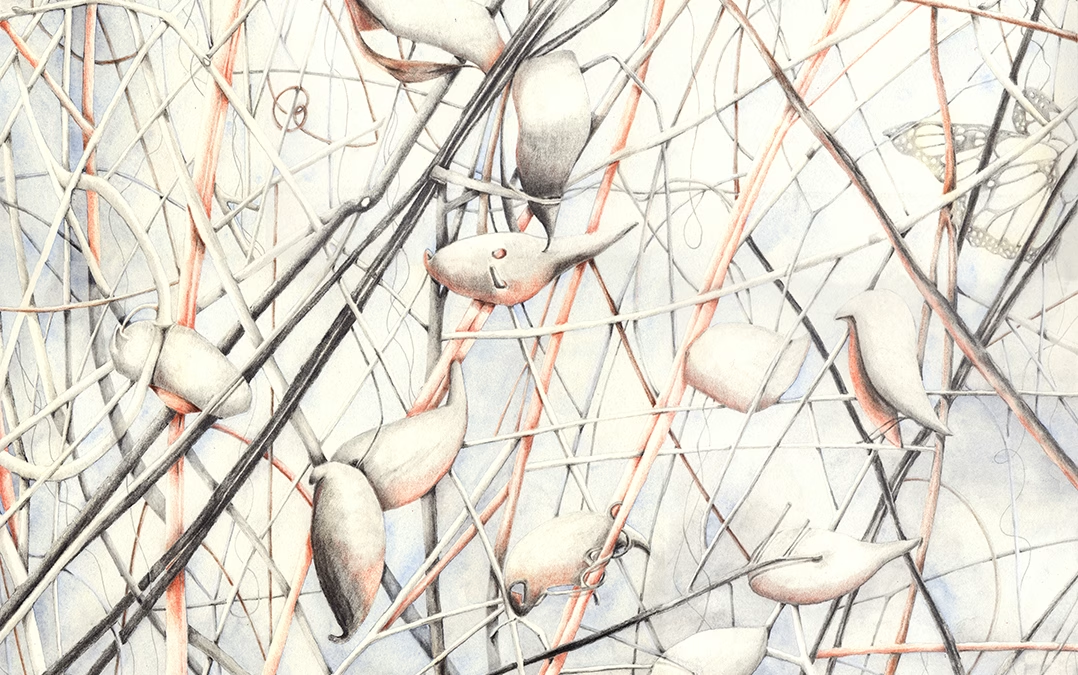
Second Note: The featured watercolor+drawing at the top of this post is a piece I did in 2017. It was my breakthrough work, moving away from small, insignificant studies of random things into a whole new direction that felt right. Titled Thicket No. 1, it shows dried milkweed pods dangling from dried stems and brush along the banks of a local lake. The “ghost” drawings of the monarch caterpillar and butterfly foreshadow a world without them if we don’t continue to protect habitat and allow milkweed plants to flourish.
Here’s a statement written by Norman Arts on artistic freedom that’s worth a read.
Your turn.
What are your feelings about artistic freedom? Are you an artist who denies themselves their own artistic freedom? Or are you an artist where outside forces suppress your and other artists’ artistic freedom?
Jot your thoughts down below. I reply to all comments.
Did this post get you thinking? Then you might enjoy these, too.
How This Artist Structures Her Week. I have been building my art career and business for about 5 years now. Something had to shift. I needed a structure that would help me move the needle without burning out. See how I plan my studio art practice week.
Bird Watching as Art Practice: I Don’t Have a Hobby. Birds have always been my go-to subject when I hit a dry spell. Yet, having an art practice based on environmental concerns, birds began to have a whole new meaning for me and my art practice. Thank you, Amy Tan.