
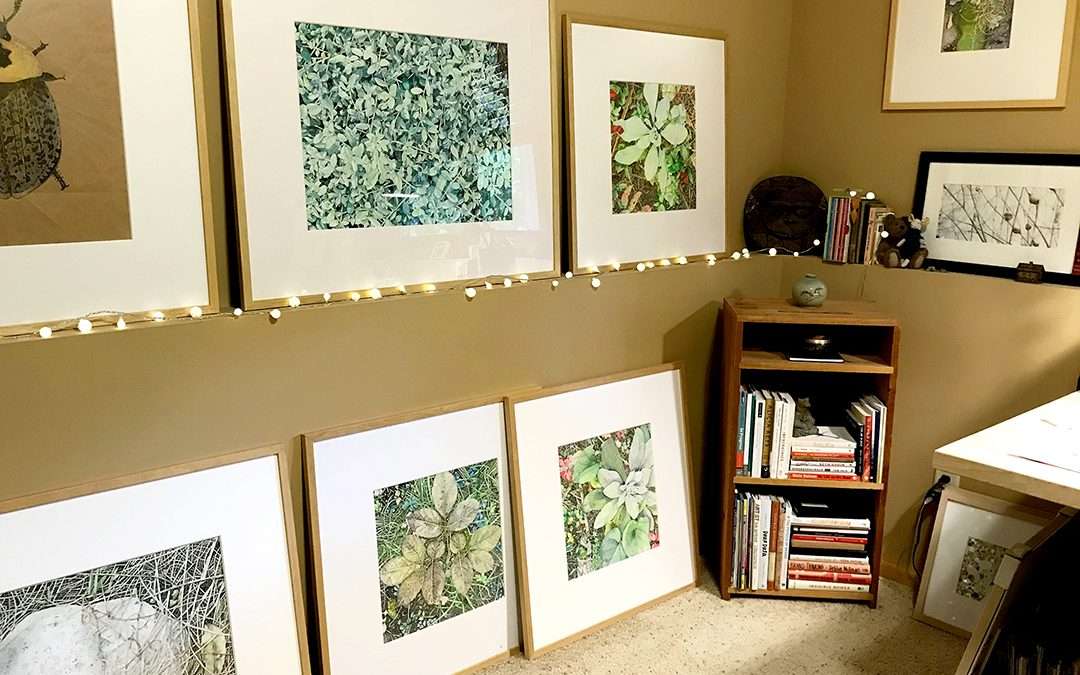
A view inside my studio, August 2023, in Lakeville, Minnesota, where I use a spare bedroom on the lower level as workspace. The surrounding artwork will soon be off to exhibit at the Minnesota Landscape Arboretum’s Reedy Gallery. I will miss them while they’re gone. Six pieces were sold at the show, finding new homes with people who love the art.
When I was growing up, living in the ranch-style house my father built, I was surrounded by art. It was mostly student work, large abstracts that I didn’t know if they were any good or not, only that I loved having them around. My father was a founding faculty member at the University of Minnesota, Morris, professor of studio fine arts and art history. It was 1963, and somehow those artworks found a home with us.
My brother and I would stand on the elongated Bauhaus-styled sofa my father built (he built most of our furniture for our home, too), and gestured at the large landscape abstract painting that hung above it. To us, the painting was our view of the surface of some distant alien planet. We were aliens, too, speaking in silly made-up gibberish until we fell over laughing. Art simply added to our imaginations and our play.
From Growing Up With Art To Becoming An Artist
Fast forward, and I am making art that is finding its way into people’s homes. There is nothing more fulfilling than having your art find a home and be seen every day. My partner and I also collect art from artists we’ve met and whose work we fell in love with.
These are pieces I see every day and give me that little burst of joy when I see them as I enter a room or pass them on the stairs. We have art hanging in every room of our home, except for the garage and laundry room. Even the walk-in closet in our master bedroom has art displayed, as do all the bathrooms.
I’m telling these stories to illustrate how important art is in our daily lives. But I also realize people have barriers when it comes to collecting art.
The term “collecting art” sounds intimidating all by itself. Art is far more democratic than that.
Art is for everyone. When I say collecting art, I mean finding and purchasing art, from the artists themselves if you can, because you love it.
Some people think “collecting art” means having to buy the “right art” because collecting the “right art” is an investment and will pay off in the future. This, too, is part of the art world— the big-time art brokers, dealers, and collectors. The dirty side of this type of art collecting is that the art is bought and sold to the highest bidder, and the artist never sees a dime from the resale of their work. I don’t think loving the artwork has anything to do with it, either.
No, indeed, I am talking about collecting art to enhance your well-being. The art you collect says something deeper about you in ways beyond how you dress or decorate your home.
The Importance of Having Beauty In One’s Life.
In his 1880 lecture “The Beauty of Life” William Morris, the father of the Arts & Crafts movement, defined art and beauty together as integral to life itself: “Beauty, which is that is meant by art, using the work in its widest sense, is, I contend, no mere accident to human life, which people can take or leave as they choose, but a positive necessity of life if we are to live as nature meant us to; that is unless we are content to be less than men.”
Morris goes on to reflect on the art of medieval times, where art had been “made by the people, for the people as a joy for the maker and the user.” His own golden rule was “have nothing in houses that you do not know to be useful or believe to be beautiful. That is to say, surround yourself with beautiful things. They elevate the human spirit.
I take Morris’ philosophy to heart. It’s wonderful to have most things I use and see daily made by artists. I do what I can when I can for fellow artists. For instance, I have a collection of little bowls made by local artists that I use while cooking. They are loved for their adornments and usefulness, but most of all because these little bowls delight me.
Art Should Be For Everyone.
I would be remiss if I didn’t acknowledge that buying original art is a luxury for many people. At the same time, art is more accessible than ever through art prints, art fairs and festivals, and open studio events where artists sell their art directly to buyers.
As I write this post-election, we need art in our daily lives more than ever, be it music, poetry, theatre, or art on the walls. I have always found art that reflects nature calming and reassuring. The art hanging on our walls is a steady, constant friend, taking me out of my worried head to feelings of comfort and peace. Things will be better again. That’s why people need art in their homes.
Your Turn.
Do you collect art? Are you an artist who buys art from fellow artists? Are there stories about the art you have in your home? Is art an important element to have in your own home, especially now when everything costs more than it did a few years ago? Add your thoughts in the comments. I respond to all. Till next time, be kind to everything that lives and especially be kind to yourself.
For more reasons why art is important, check out Part 2.
Part 2: Why People Need Art in Their Homes. A list of compelling reasons why art is important for our lives and well-being.
Kristin, I found your article through Facebook. How fun to see a bit of what you are doing these days! Your art is lovely. And you’re right — it is calming. Not only were you my student decades ago, but we were neighbors on Highland Drive. Allan has had much more time to do art since he finished his teaching career.
Paula, how wonderful to hear from you! You were by far my favorite English teacher of all time. You challenged us and made us think. I also took a creative writing course held at the UMN library one summer. I’m delighted you think my art is calming. I bet Allen has more time to devote to his art now that teaching is behind him. I wouldn’t be at the level I am at now if I was still working as a graphic designer.